
How Much Productive Time Is Lost to Digital Friction?
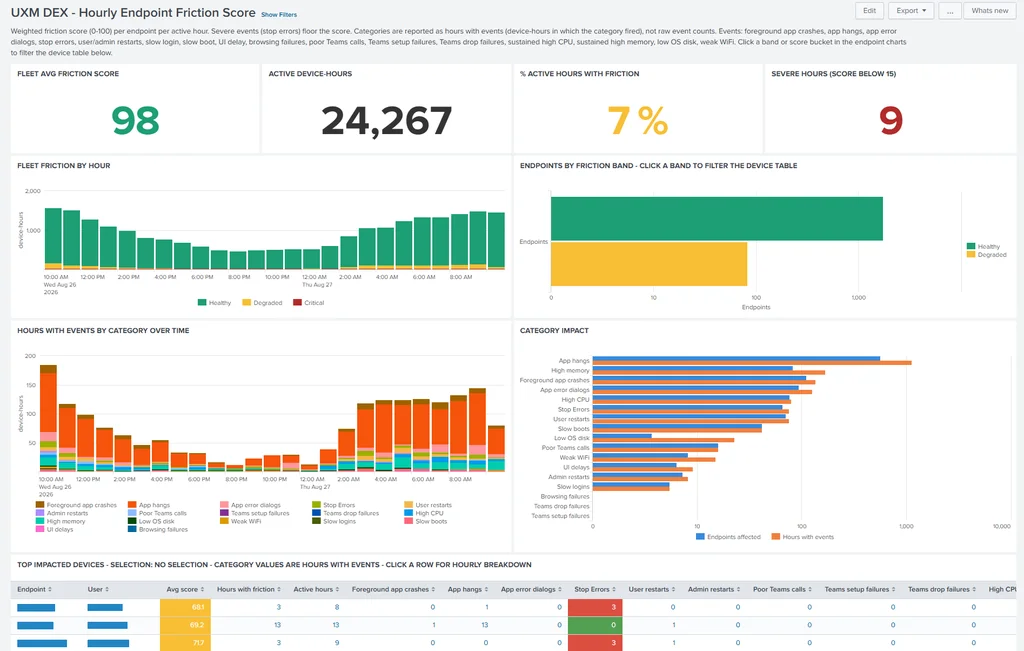
Recurring technology delays can affect working time without causing a visible outage. UXM helps IT teams understand where this friction occurs, investigate its causes, and use the evidence to prioritize improvements and investment.
An employee waits for a customer order to load. Another restarts an unresponsive application. A team experiences recurring delays in its virtual desktops. Work continues, but completing everyday tasks takes longer than it should.
Individually, these experiences may appear insignificant. Across an organization, their cumulative effect becomes harder to ignore.
For IT leaders, the challenge is understanding which problems account for that disruption and what action will make the greatest difference. Friction scoring and friction hours help connect technical performance with the employee experience, providing a stronger basis for those decisions.
Look Beyond Outages and Support Tickets
Digital friction describes technology-related conditions that delay, interrupt, or complicate work. It can include slow application responses, unstable Wi-Fi, endpoint resource constraints, VDI interface delays, or poor performance during online meetings.
These conditions do not always generate an alert or a support request. Employees may tolerate slow performance, restart an application, or ask a colleague for help. Although a workaround can restore access temporarily, it also takes attention away from the employee’s work and may leave the underlying problem unresolved.
As a result, ticket volume provides an incomplete picture. A recurring problem affecting an entire department may attract fewer reports than a more visible issue affecting a handful of employees.
UXM’s real-user monitoring helps IT teams investigate performance during actual application use. By connecting application behavior with endpoint, network, and session conditions, teams can examine where technology interferes with work, including experiences employees have not reported.
Use Friction Scoring to Identify Degraded Experiences
Technical measurements such as response time, latency, CPU utilization, and memory consumption remain essential for diagnosis. Their significance depends on the context in which they occur.
A brief increase in resource usage may have little effect on an employee. The same condition occurring repeatedly during an important business transaction may warrant investigation.
UXM’s configurable friction scoring helps organizations assess endpoint experience against performance conditions relevant to their environment. It provides a structured way to identify degraded experiences and recurring patterns, while the underlying technical data supports further investigation.
The score helps IT determine where to look. Application, endpoint, and network evidence helps explain what happened.
Make Affected Working Time Visible With Friction Hours
Friction hours express disruption as an estimate of working time affected by degraded technology. They add duration and employee reach to the assessment of a performance problem.
An event count might show that an application exceeded a response-time threshold repeatedly. Friction hours help put those conditions into an operational context:
- How widely employees experienced the degradation
- How much working time was affected
- Whether the issue is isolated or recurring
This distinction matters when setting priorities. A short-lived issue affecting a few users may have less cumulative impact than a recurring delay affecting hundreds of employees throughout the day.
Affected time should not automatically be treated as entirely lost productivity.
Employees may continue working at a reduced pace, switch tasks, or use a workaround. Equally, every friction hour cannot be converted directly into a fixed financial loss without additional assumptions about the work involved.
The practical value is a clearer basis for comparing disruption, prioritizing investigation, and tracking improvement.
Establish Governance for Acceptable Performance
Friction measurement becomes more useful when the organization has agreed what acceptable performance looks like and how to respond when it deteriorates.
Without shared standards, priorities can depend on individual tolerance. Some employees accept recurring delays as normal, while others report similar experiences immediately. Clear governance gives IT and business teams a common basis for assessing disruption.
This means agreeing:
- Which performance conditions require attention
- How long or how frequently they can occur before investigation is needed
- Who owns the response
- How business-critical processes should influence priority
A delay affecting a critical customer transaction may require urgent action even when relatively few employees are involved.
UXM’s configurable friction scoring can support these agreed standards, while friction hours provide context about the scale of the disruption. Monitoring and configurable alerts help teams identify deteriorating conditions before employees raise tickets.
These standards should remain open to review. Changing applications and working practices may require different thresholds, and reported problems still deserve investigation even when existing measures do not capture them.
Understand the Cause Before Investing in the Solution
Knowing where friction occurs can improve both incident prioritization and financial decisions. Before committing to new endpoints, application changes, or network upgrades, IT needs evidence about what is contributing to poor performance.
A slow application does not necessarily mean an employee needs a new laptop. The delay may relate to:
- Application response time
- Degraded Wi-Fi
- Network latency
- Conditions within a virtual desktop session
Replacing the endpoint could leave the problem unresolved.
Conversely, persistent memory pressure or other endpoint constraints may provide a sound reason for a targeted upgrade or replacement.
UXM brings application, endpoint, and network performance together so teams can examine conditions during the affected period. Comparing users, locations, devices, and sessions helps them investigate likely causes and assess where corrective action is most appropriate.
This supports more targeted investment. Rather than relying solely on device age or a scheduled refresh cycle, organizations can use performance evidence to decide which endpoints need replacing, which may benefit from an upgrade, and where application or infrastructure improvements deserve priority.
The resulting investment proposal becomes more concrete:
- Which employees are affected?
- What evidence supports the proposed change?
- What improvement should be evaluated afterwards?
Verify That Action Reduces Friction
An upgrade or configuration change is only useful if it improves the experience it was intended to address.
Before making a change, IT teams can establish a baseline for the affected users and services. Afterwards, UXM’s historical performance data helps them assess whether disruption:
- Became less frequent
- Lasted for less time
- Affected fewer employees
Consistent thresholds and comparable user groups and working periods make these comparisons more meaningful. They also help teams determine whether performance has returned to agreed acceptable levels or whether further investigation is needed.
For example, after an endpoint upgrade, IT can examine whether resource constraints and associated delays have declined. Following a network change, teams can assess whether affected locations experience fewer connectivity problems and less friction.
This gives management evidence of the result, beyond confirmation that equipment was purchased or a project completed. It also helps IT refine future decisions by understanding which interventions delivered an observable improvement.
Turn Friction Insight Into Better Decisions
Friction scoring helps identify degraded digital experiences. Friction hours help describe their duration and reach. Connected performance data supports investigation, while established governance defines how the organization responds.
Together, these capabilities give IT teams a stronger basis for addressing recurring disruption, directing investment, and demonstrating whether their actions improve daily work.
More from the Blog
TURN INSIGHTS INTO ACTION
See UXM in action
UXM brings performance, health, and usage data together so you can make confident decisions across your digital workplace.
Fast deployment
•Real-world data
•Confident decisions