
Employee Productivity and Governance Across Enterprise Application Services
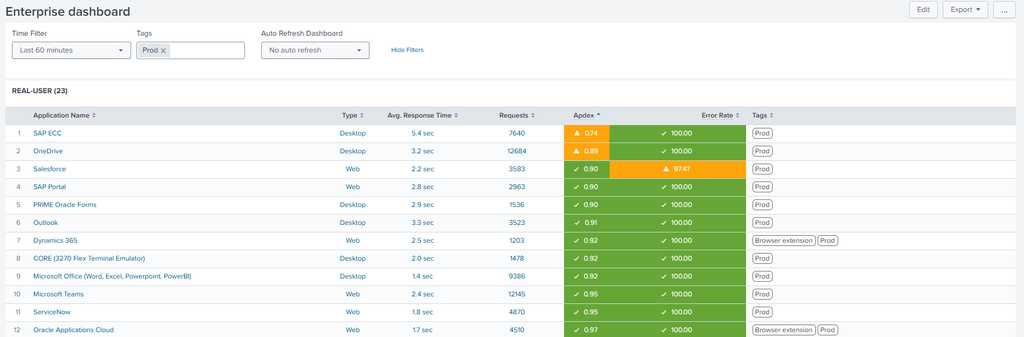
UXM gives IT a consistent view of service quality across internal and vendor-managed applications, helping teams reduce disruption, uphold company standards, and strengthen supplier accountability.
Employees depend on a connected set of SaaS, web, desktop, virtual, and legacy applications to complete their work. Some services are managed internally; others are delivered by vendors. Employees experience them as one working environment, and a failure anywhere in that environment can interrupt productivity and increase IT support demand.
Enterprise governance therefore needs a consistent view of whether every service meets the company's expectations for availability, responsiveness, reliability, and employee experience.
UXM connects real-user activity with application, endpoint, virtual session, and network performance. This gives IT a shared evidence base for managing internal services, reviewing vendor performance, and directing action where service problems have the greatest business impact.
Apply Consistent Standards Across Every Service
Different ownership models should not create different standards for employees. A vendor-managed SaaS application and an internally supported desktop system should both be assessed according to whether employees can complete important work reliably and within agreed performance thresholds.
UXM provides a common measurement approach across the application estate. IT can monitor real response times, errors, availability, and the experience of affected users, regardless of who operates the underlying service.
Configurable dashboards and alerts help teams align monitoring with company policies, service objectives, and governance processes.
This consistent view makes service reviews more comparable. Internal owners and external providers can be assessed against the same evidence, using a consistent definition of acceptable employee experience.
Protect the Workflows Employees Depend On
An application may appear healthy overall while a critical activity repeatedly delays work. Employees might move through menus without difficulty but wait when opening invoices, submitting timesheets, or searching for customer orders.
A basic availability check will not reveal that loss of productive time.
UXM's business transaction monitoring shows performance at the activity level. IT can identify slow workflows, determine which users and locations are affected, and prioritize issues according to their frequency, reach, and business importance.
This focuses service management on the work employees need to complete, rather than on whether an application is merely online.
Coverage across SaaS, web, desktop, virtual, and legacy applications supports the same approach across the systems employees use every day.
Resolve Service Problems With Connected Evidence
A slow application does not automatically mean the application itself is responsible. Endpoint resource constraints, poor connectivity, a virtual session, or a vendor-hosted component may contribute to the delay.
UXM connects application response times and errors with endpoint and network conditions. Teams can compare affected users, examine individual sessions and transactions, and narrow down the likely cause.
This shared evidence reduces repeated troubleshooting and unnecessary handovers between support, application, infrastructure, and supplier teams.
Faster diagnosis supports lower mean time to resolution and helps employees return to reliable service sooner. It also gives each service owner a clearer basis for deciding who needs to act.
Hold Vendors Accountable for Employee Experience
Vendor reports often describe the health of the service from the provider's infrastructure. That view may not show what employees experienced when they used the service through company devices, networks, and virtual environments.
UXM adds evidence from the employee's point of use. IT can compare actual response times, errors, affected transactions, and user groups with agreed service expectations.
When responsibility is unclear, the data helps teams ask specific questions and distinguish a supplier-side issue from conditions within the enterprise environment.
The same evidence can support service reviews, escalation, and follow-up. After a vendor makes a change, historical comparisons help IT assess whether performance improved and whether the service has returned to the required standard.
This creates practical accountability based on observable employee experience.
Address Recurring Problems Before Support Demand Grows
Employees often retry, restart, or tolerate delays without submitting a ticket. Unreported problems can continue while workarounds consume time, and the underlying cause remains unresolved.
UXM's real-user monitoring and configurable alerts help IT identify deteriorating performance without relying solely on employee reports.
Synthetic testing adds scheduled checks on application availability and performance, including outside business hours.
Earlier investigation gives teams an opportunity to address recurring conditions before they affect more employees or generate additional support requests.
Alerts and trends also help service owners identify when performance is drifting away from governance thresholds.
Direct Spending Towards the Right Improvements
Understanding the cause of poor performance helps IT decide where investment is justified.
Replacing endpoints may help when device resources are consistently insufficient. It may achieve little when the delay originates in an application service, virtual platform, or network connection.
UXM provides evidence to support targeted upgrades, configuration changes, application improvements, and vendor remediation. Usage insight can also inform licensing decisions when it is combined with relevant licensing data.
A Software Asset Manager at an organisation with 25,000 endpoints described this additional benefit:
"By integrating license token data into UXM and correlating it with application usage, we uncovered actionable opportunities to optimize Adobe and AutoCAD licensing costs."
Software Asset Manager, organisation with 25,000 endpoints
Performance and usage evidence help organisations identify where spending can improve employee experience, where licensing costs warrant review, and where a supplier should correct service quality before further investment is considered.
Demonstrate Compliance and Improvement
After an application update, endpoint upgrade, network change, or vendor remediation, IT needs to establish whether employees experienced an improvement and whether the service now meets the required standard.
UXM's historical performance data supports comparisons before and after an intervention.
Using comparable user groups, working periods, and performance thresholds, teams can assess whether response times improved, errors declined, and recurring delays became less frequent. Management can follow the results through dashboards and trends.
A Vice President IT at a global enterprise with 3,000 endpoints described the value of this shared visibility:
"The true performance of an application is made totally transparent in real time through UXM. It presents performance data for all audiences, from dashboards and trends for executive management, down to individual transaction details for developers. UXM provides invaluable immediate evidence of whether a change has been effective in improving performance."
Vice President IT, Global Enterprise with 3,000 endpoints
This connects technical investigation with governance and accountability.
Developers can examine individual transactions, service owners can verify compliance with internal standards, and IT leaders can use the results to demonstrate progress, challenge vendor performance, and guide further investment.
More from the Blog

TURN INSIGHTS INTO ACTION
See UXM in action
UXM brings performance, health, and usage data together so you can make confident decisions across your digital workplace.
Fast deployment
•Real-world data
•Confident decisions